
Links for July
The Odyssey, John Locke, interpretability

Here are the most interesting things I read, listened to, and watched in July. But first, some announcements:
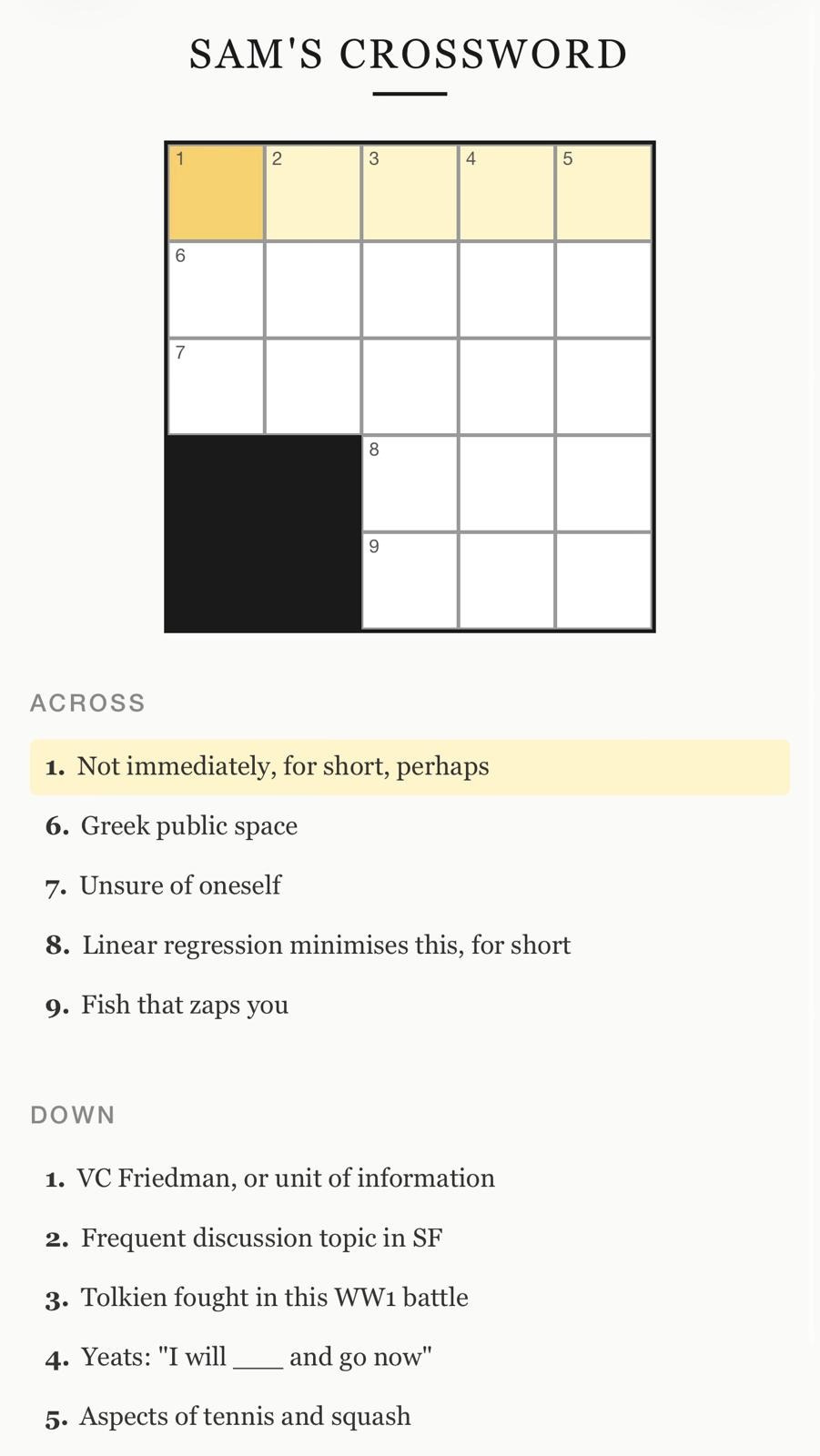
1. This year, I cohosted a 4th of July party in suburban California, and the prevailing mood about how the whole “America” thing is going was gloomy. Here is a crossword puzzle that I made for the occasion. Only one of these is a word I made up:
2. The Arq Foundation is hiring a ‘breakthrough innovation researcher’ to work on improving science policy in Brussels. Let me know if you’re applying and would like me to put in a good word for you so that I get the referral bonus.
3. My ‘to-read’ tab on Instapaper has now hit over 3,500, and I’ve engaged in a mass-desubscription from Substack newsletters.1 It may also be time to declare blog post bankruptcy.
Table of contents
Blogs and short links
Last month’s links were featured on Marginal Revolution. They were also abridged and reposted on EconLog.
Congratulations to the new cohorts of Emergent Ventures winners.2
Against the existence of Reasonable Blackman.
Scott Alexander’s Links for July, part one:
In 2023, I reviewed the evidence for declining sperm counts and concluded it was shaky. Since then, a new meta-analysis has found no evidence of declining sperm concentration.
And part two:
A new crop of polls on data centers helps clarify public opposition. Data centers are extremely unpopular, but few opponents claim to be motivated by dislike of AI; rather, they cite environmental concerns (especially water and electricity use). In fact, people oppose other AI infrastructure (such as chip manufacturing plants) significantly less than they oppose data centers, and support for non-AI data centers (like for internet services) is barely above that for AI centers (11% vs. 9%). I think the best explanation is that Americans are extremely confused about what is and isn’t bad for the environment, and have been memed into thinking data centers are environmental megavillains in the same way a past generation was memed into thinking nuclear plants are (in recent polls, 50% more Americans would support a nuclear plant being built next to them than a data center!)
Questions that are rarely asked: How has the average length of time that elapses per page in a novel changed over time?
Update from the Vesuvius Challenge.
You’ve probably already seen that the Jacobian conjecture in algebraic geometry was just disproven by a tweet. Dare I say this is the greatest mathematical discovery to emerge from a cesspool of internet trolls since the lower bound on superpermutation length was proven by an anonymous 4chan commenter?
Ben Yeoh links to me linking to him, and in the process describes me as “esoteric”. Should I be offended? Flattered?
Best of Twitter: It’s not often that I wish I grew up in China, but there is one specific way in which it would have been cool – the ability to take day trips to see the world’s most incredible factories. There is also the return of the Irish Federal Reserve.
Best of Wikipedia: Georgy Zhukov, head of the Soviet army in WWII, became enamoured with Coca-Cola after being introduced to it by Dwight Eisenhower. However, as the symbol of American capitalism, there was no way that it would have been politically possible to import Coke directly. Zhukov’s request for the drink made it all the way up to Harry Truman, whose staff contacted the Coca-Cola export board, who in turn had their chemist strip out the caramel colouring to make the drink clear, and shipped it to him in straight-sided bottles adorned with a red star. Thus, the birth of White Coke.3
Andy Masley claims that, among people who work in policy in DC who express strong opinions about China, only half know who Deng Xiaoping was. David Shor chimes in that only 12% of Americans know who Deng was. For shame!
Ben Southwood and Kara Dimitruk argue that the Glorious Revolution smashed the NIMBYs and therefore caused the Industrial Revolution. After William III became king in 1689, Parliament started passing a lot more legislation, much of which clarified and strengthened property rights.
The British aristocracy was very neurotic about inheritance: it was common for the children of a landed family to squander away mum and dad’s estate. British inheritance law was pretty complicated – you can’t follow a Jane Austen novel without knowing it. This is a diagram of a particular mechanism for this called ‘strict settlement’, which emerged in the 1650s:
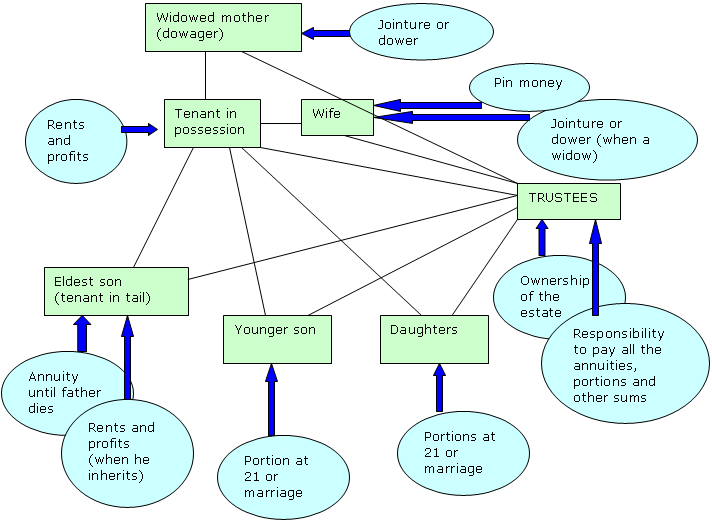
We’ll skip over the details, but Southwood and Dimitruk argue that a major problem with strict settlement was that it tied up land; if a plot would be vastly more economically productive if it were sold, then it would often be difficult to do so unless the entire family was unanimous. But the post-Glorious Revolution Estate Acts started to allow resale of the land and other use of resources on a case-by-case basis. Scattered strips of land were consolidated, and the open-field system was progressively dismantled by the Inclosure Acts. Road quality was also improved dramatically by turnpike trusts that were founded by landowners and merchants, which charged tolls to finance maintenance.
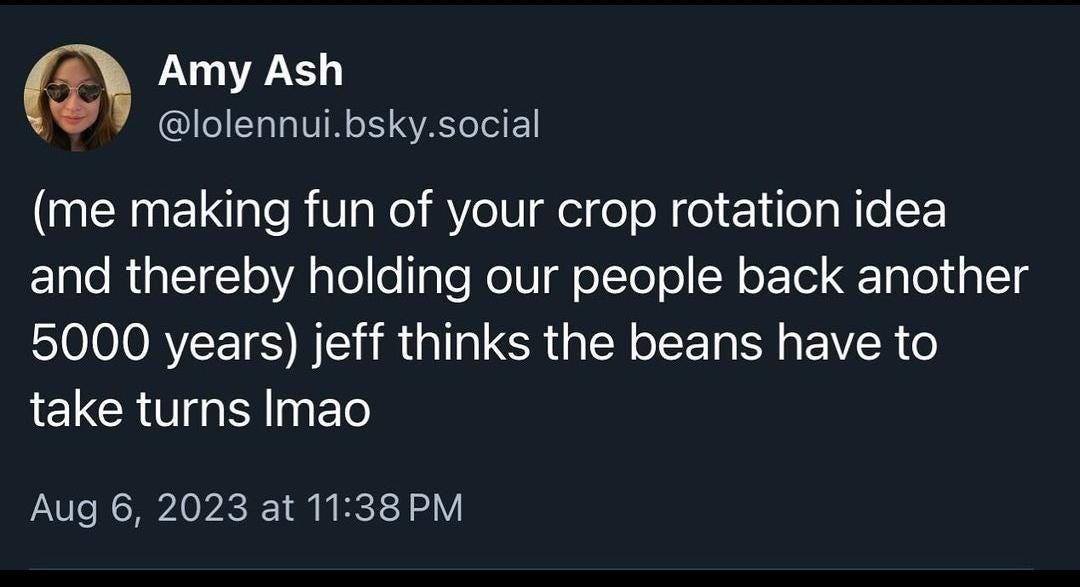
The link with the Industrial Revolution is that these strengthenings of property rights (allegedly) gave capital-owners an economic incentive to invest in automation, and gave a legal status that allowed for new agricultural methods like Norfolk crop rotation.
Here is a contrary take from anonymous economic historian Pseudoerasmus. As I understand it, the counter-claim is that the reforms to land ownership and property rights that came in the wake of the Glorious Revolution did cause British agriculture to make more efficient use of a given unit of labour or capital,4 but that this process was essentially orthogonal to agriculture’s also getting more productive through technological change. As the article itself notes, some countries maintained an almost-pre-1689-Britain level of messed-up property rights until after WWII, but were still able to become advanced economies through technological improvement.
Being Irish, I have a particular sensitivity to the way that the events following the Glorious Revolution have been, uhm, selectively interpreted according to one’s preferred political persuasion. In any case, I’ll be thinking and reading a lot more about the 17th century in the next few months.
The philosophical underpinnings of H.P. Lovecraft’s fiction, toroidal geometry in M.C. Escher, Dundonian poetry, the pagan origins of Saint Brigid, the state of atheism in mediaeval Europe, the cultural context of Father Ted, Winnie Nelson, and other things Peter McLaughlin thought or read about in April.
Podcasts
The Partially Examined Life boys on John Locke’s epistemology, part one, two, three, four.
Rahul Sagar on the underrated role that Mama Parmanand played in the birth of Indian liberalism.
Melvyn Bragg and guests on Ulysses.
The Very Bad Wizards on William James on attention.
Basil Halperin on macroeconomic impacts of AI. Basil is always good on this topic, but I found this most valuable for the discussion of Calvo’s model of sticky prices. That is some clean New Keynesian theory from the 1980s in which there is an exogenous per-period probability that any given firm will be able to change its price. This provides the deep theoretical justification for stable inflation targeting, the current regime of central banking.5
Basil’s job market paper from earlier this year tries to work out the optimal monetary policy when firms can always choose to update their prices in response to inflation but face some cost in doing so (menu costs). He concludes that the best such system is our old friend nominal GDP targeting, i.e. that central banks should instead target a specific rate of increase in non-inflation-adjusted output growth. Intuitively, I am inclined to believe this, because the person most associated with the NGDP targeting idea (Scott Sumner) has incredible film taste.
Jan Swafford on the music of George Gershwin and Igor Stravinsky.
Dwarkesh Patel and Ada Palmer on how Machiavelli is completely misunderstood. There are many claims made here, most of which I’m not qualified to evaluate. One of them is the idea that copyright historically grew out of censorship. The earliest form of copyright was first granted in the inquisition, in which the author of a book verified as not being on the index of forbidden books would receive exclusive rights to print it. Palmer’s stronger claim that England’s system of copyright was directly modelled after this system from the inquisition seems to be more of a contested minority position.
Music
This month, I upgraded to AirPods Pro 3. My original AirPods Pro from 2019 had almost entirely lost their noise-cancelling attributes; although this is primarily an issue with the silicone tips, Apple has quietly stopped selling replacements for models that far back. This experience has reminded us all of the critical importance of good headphones, and I am living in a sonic wonderland once again.
Some new albums discovered, or listened to properly, for the first time this month.
Joey Alexander, Continuance. Alexander was twenty when this album came out, so it’s interesting to hear his sound maturing; Ted Gioia gives us reasons to forgo premature judgement of jazz prodigies. My personal favourite track is Why Don’t We. And here is Alexander aged 13 playing with the Jazz at Lincoln Center Orchestra.
My Bloody Valentine, loveless. My Bloody Valentine was early to the trend of putting things all in lowercase, before it became so ubiquitous that merely using grammar became a form of countersignalling. In Tyler Cowen’s post on his favourite things about Ireland, he calls loveless possibly his favourite album of all time. This is one of the albums that created the shoegaze subgenre, and it was rated by Pitchfork as the greatest album of the 1990s. I love only shallow. The rest of the album doesn’t do much for me, but I will trust that the market is efficient and keep trying.
The Frames, Fitzcarraldo. The album from 1996 which established the sound of Glen Hansard’s rock band. My favourite track is Fitzcarraldo. If you have not seen the news, Hansard passed away in a motorcycle accident last week in Dublin. Once, which he starred in, is one of my favourite Irish films. A lot of Irish people have been taken off guard recently about how famous it turns out Glen Hansard was internationally; even Barack Obama tweeted about him. Rest in peace.
Herbie Hancock, Mr. Hands. An underrated gem nestled between what seems to be generally regarded as Herbie’s creative low point during the disco era, before he ventured even further from jazz into electro. My favourite track is Just Around the Corner.
Papers
Alec Radford et al., Learning Transferable Visual Models from Natural Language Supervision. The Fitzilliam AI Circle this month was on the topic of multimodality, and we took our first steps in playing around with vision transformers and diffusion models. This was maybe our most technical event yet, but you can read the discussion prompts here. Most of our readings for that were based on Deep Learning: Foundations and Concepts by Bishop and Bishop, which I continue to inch through.
This is the paper from 2021 that introduced Contrastive Language-Image Pre-training (CLIP), OpenAI’s model that jointly embedded images and their natural language descriptions. This gave it surprisingly good “zero-shot” performance, i.e., you could show the system an image of something it had never seen before, and it would do a pretty good job identifying similarity to the existing labels.6
You probably know about ImageNet, the dataset of labelled images that became a common reference for computer vision, and which AlexNet in 2012 had an amazing performance at classifying, thus triggering the deep learning revolution. One of the issues is that these methods tend to overfit to the particularities of ImageNet, and their performance craters on other images. But CLIP remained accurate on other datasets.
Toward the end, there is the obligatory section about bias, and the social implications of building systems that (e.g.) could be used to engage in mass surveillance. Thankfully, OpenAI would never let its technology be used for that.
Edward Glaeser, Joseph Gyourko, The Economic Implications of Housing Supply. This Journal of Economic Perspectives review paper may well be the best resource to send to someone sceptical of the claim that the primary cause of the growing unaffordability of cities is zoning and other legal barriers to construction. I re-read this for my forthcoming journal club on urban economics, for which you can read the discussion prompts here.
A few surprising conclusions from this paper:
From what I can tell, America does not have a generalised housing shortage. It has a post-1970 housing shortage in a small number of superstar cities. The key ratio is between price and the minimum profitable production cost (P/MPPC). If this number drops below 1, then the building would not be worth rebuilding, if it were destroyed. If I’m reading Table 1 correctly, in 2013, 57% of houses in America had a P/MPPC of less than 1, which means that most houses are not worth rebuilding, economically speaking.7 8 However, a small number of cities have a P/MPPC consistently above two: It would cost more than twice as much to buy the house as to rebuild it. This, arguably, reflects a “regulatory tax” that makes land artificially scarce in those cities.
Contrary to popular belief, construction costs are not actually that much higher in very expensive compared to inexpensive markets.
Real construction costs did not rise much in the 35 years leading up to this paper being published in 2018 (page 9). The oft-discussed declining productivity of the construction sector is less important than a lot of people think.
One of the issues going forward is trying to figure out which specific regulations constrain supply the most. The evidence is pretty weak regarding how much supply is restricted by the National Environmental Policy Act9 versus minimum lot sizes versus parking minima10 versus specific forms of zoning. We know that jointly they restrict supply a lot, but reasonable people can disagree about the relative benefits of abolishing each one (and indeed, the relative costs).
Not that we really needed more examples of how the current regulatory environment around construction is completely dysfunctional when it comes to actually serving environmental goals, but I also note that “[b]uilding restrictions are higher in places that have lower carbon emissions” (p.27).
Hsieh and Moretti (2019) is a famous paper that builds an economic model that predicts that if just New York, San Francisco, and San Jose lowered their level of land use regulation to the level of the median US city (still very far from full deregulation!), national GDP would grow 9%. This is under an assumption of perfect mobility; their preferred number accounting for more realistic relocation frictions is 3.7%.11
If you follow the econ blogosphere, you may have seen what comes next. In 2021, Bryan Caplan found an elementary mathematical error in the paper, but it actually made the result almost twice as strong. Then Brian Greaney in 2023 found a coding error in the original paper that reversed the sign of the original result (i.e. the model predicted that aggregate output would decrease under this set of YIMBY policies).12 Greaney also showed that the model had other weird features, such as unit-dependence (it gave a different answer if you count people one at a time, or in groups of thousands, or millions).13 Once Greaney corrected for them, he was able to recover the original effect but with a much reduced magnitude, predicting a 0.02% increase in output.
Glaeser and Gyourko’s paper predates this whole debate, but they’re still sceptical. The implied elasticity of city-level labour demand in Hsieh and Moretti’s model is -7.5, which is way larger than empirical estimates of that quantity, which range from -0.25 to -1.0. When you plug in those more realistic elasticities to their model, you get much smaller but still respectable 1-2% growth in national output from (this particular instantiation of) YIMBY.
I first came across this four years ago, when I was talking to an urban economist who mentioned that the canonical paper underlying the worldview in which building restrictions are a major impediment to economic growth assumes that the population of New York would swell by over 100 million to achieve those benefits. I’m sorry, what?!
It’s actually even more extreme than this, because employment in New York in Hsieh and Moretti’s model increases by 1,010 percent. When you account for the fact that only about half of the total population is employed, it implies about 190 million people would live in the New York metro area, and 40 million in the Bay Area. Obviously, nobody thinks this is actually going to happen, but it is an implicit prediction of the model under the policy change being studied.
Come to think of it, maybe 9% higher GDP isn’t crazy, in a “if my grandmother had wheels, she’d have been a bicycle” sense. This would represent such a radical shift in the choices of the population compared to all of recent American history that the sky is the limit. Anyway, the criticisms of this methodology certainly predate the more recent claims that Hsieh and Moretti made mathematical and programming errors.
In the present day, as we approach an IPO for OpenAI and Anthropic, San Francisco is building new housing at a 15-year low and new apartment construction is down 50% just in the last year.14 Humanity continues to run a collective experiment in what fraction of the economic value of our future lightcone can be destroyed by the San Francisco Board of Supervisors.
Ronan Lyons, Housing Prices, Costs, and Policy: The Housing Supply Equation in Ireland Since 1970. This is the most up-to-date and detailed evidence I’m aware of about how elastic the supply of Irish housing is. This is very important, because most of Ireland’s policy problems are ultimately downstream of the relationship between prices and construction.
The headline is that the elasticity of new housing supply to prices is +0.9, i.e., if prices get 1% more expensive, then 0.9% more of it is built. The elasticity of supply with respect to costs is –1.9 (i.e. 1.9% less is built when it gets 1% more expensive to build). Responsiveness to prices rose after the 1980s, fell in the 2000s, and now has risen again.
This is strange. Glaeser seems to be saying that construction costs are not that big a deal, because 50%+ of the cost of housing in desirable metro areas reflects a regulatory tax. But Ireland only has one big city, whose housing supply is extremely restricted, but is also somehow very responsive to changes in construction costs. I still don’t really get this.
One of the idiosyncratic features of the story of Irish housing supply is the extremely generous (“section 23”) tax incentives for construction in Ireland during the Celtic Tiger. This was a highly unusual setup in which landlords received a tax deduction equal to the entire selling value of a property minus the cost of the land (so basically, construction costs plus profit). This meant that landlords frequently paid zero tax on their rents net of maintenance costs, even though this would have been taxed as income in any other country.
Section 23 only ever applied in a small number of designated areas, perhaps most famously in County Leitrim.15 This was a hugely perverse system in which the tax deduction was highest in areas where land values were lowest. A significant fraction of the Irish population has been one-shotted by the idea that Ireland overbuilt “ghost estates” because of… capitalism run amok? Because leaving developments sitting empty is somehow more profitable than renting them out? But this was, in fact, a direct consequence of the design of the tax system. Irish politics is still living with the consequent level of supply scepticism.
I am yet to write a proper essay on the Global Financial Crisis, but one of its more underappreciated aspects is Kevin Erdmann’s point that, by the time that Lehman Brothers collapsed, employment in the construction sector was back to its long-run historical norm. The idea that a recession in some sense “had” to happen to reallocate the excessive number of workers building houses fueled by cheap credit is false. However, the view that people might have about America is approximately true of Ireland, in that the construction workforce (which peaked at 13% of all workers!) fell off a cliff only after the banks imploded. Pretty much every Irish person has at least a family friend who worked in construction before that, then either emigrated or decided to do something else.
Ronan Lyons et al., The Price of Housing in the United States, 1890–2006. Ronan is pursuing the classic economist playbook of publishing in prestigious international journals about America (in this case the QJE), in order to subsidise being interested in your home country. This is a great paper: he and coauthors have used a digitised database of newspaper clippings to track the long-run trend in housing prices.
It’s really hard to make price comparisons over a long period of time; every way of measuring inflation has its own flaws. And it’s even harder to do quality adjustments. What we really wish to know is whether one square metre of floor space in an equally nice dwelling has been getting more or less affordable.
The previous attempt I was aware of to do this is the Case-Shiller index, which measures market movements among the same buildings that sell twice. From this paper I learned that the Federal Housing Finance Agency has produced a house price index going back to 197516 and that the Bureau of Labor Statistics has also been running surveys about the average rent since 1914.17
There are tricky issues here about how to separate out the capital gain of housing from the rental benefit, in order to calculate what the long-run rate of return on housing is. The authors find the former is not terribly significant relative to the latter.
At a personal level, this is relevant to whether it ever makes economic sense to buy a house, given that you could go into debt when you are young in order to buy stocks instead. In their dataset, there were only three brief windows in which housing has beaten the return on equities.
When they crunch the numbers, the paper’s first conclusion is that real rents rose over the 20th century, in contrast to the BLS data, which indicates that rents fell by half between 1914 and 2006 (wait, what?!). Later, house prices really take off relative to rents: “Sale prices were 140% higher in 2006 than 35 years earlier, rents were just 5% higher”. There is also some pretty wild disagreement about what house prices were doing up to and during the Great Depression:
[W]e find real prices rose by 73% from 1918 to 1928 (rather than 5%, in Shiller) and then fell by 28% from 1928 to 1935 (rather than rising a further 4.5%, per Shiller).18
Anton Howes, The Spread of Improvement: Why Innovation Accelerated in Britain 1547-1851. Eventually, we will get Anton’s magnum opus on the Industrial Revolution. In the meantime, I only have this working paper.
Obviously, a lot of ink has been spilt about why the Industrial Revolution happened in Britain when it did. The structural arguments (like that Britain had unusually cheap coal and high wages) have never been particularly convincing, partially because British wages look a lot lower depending on how you choose to classify contractors, and also because the field now mostly believes that British wages were high (insofar as they were) because the workers were already genuinely more productive. And that only pushes us back a step to explain why British workers became more productive.
Anton says that the answer is culture. The default state is for humans to not be particularly interested in improving things. There was a lot of low-hanging fruit at the beginning of the Industrial Revolution that seems like it could have been invented centuries earlier, like the flying shuttle. Britain was the first place to develop an “improving mindset”, which was systematically spread through a Republic of Letters and a network of clubs and societies such as the Lunar Society. This latter attribute of spreading the improving mindset was missing among earlier flowerings of invention in other countries, like during the Tang and Song Dynasties.
Part of spreading the improving mindset was discouraging innovation-destroying rent-seeking. James Watt aggressively policed his patent on the steam engine, but that was a minority pursuit; it looks like it is still contested whether this in fact delayed the rollout of steam power.19
To explore this, Anton created a sample of 1,452 innovators, the largest such systematically studied sample, primarily to identify when they made their first invention.20 Your mileage may vary on how convincing you find these inherently woolly analyses compared to quantitative economic history.
John Stuart Mill, Civilization. It feels good to be re-reading Mill, who I didn’t enjoy as much the first time around. This is one of his lesser-known essays, but I thought it was a gem. I was also surprised to learn that spelling Civilisation with a ‘z’ is the traditional British way of doing it; the frequent use of ‘s’ is a later piece of French cultural influence.
In the essay, Mill is basically arguing that the central tendency of civilisation is to transfer power from individuals to the masses. I see Mill as arguing, throughout his career, that democracy is coming whether we like it or not, and thus that we should try to ensure that such a system promotes liberal values. I have a forthcoming piece about Mill’s role in the history of ranked choice voting electoral systems that explores this.
On page 133 of the Library of Economics and Liberty version, he writes about how, when competitors become too numerous to individually evaluate, reputation and merit become decoupled:
Quackery there always was, but it once was test of the absence of sterling qualities: there was a proverb that good wine needed no bush. It is our own age which has seen the honest dealer driven to quackery, by hard necessity, and the certainty of being undersold by the dishonest. For the first time, arts for attracting public attention form a necessary part of the qualifications even of the deserving.
He’s also very critical of the (he argues) weak intellectual value of an Oxbridge education, and of Britain for not producing more great thinkers. In this context he approvingly cites William Whewell, a previous winner of our Victorian polymath of the month award:
Is it astonishing that great minds are not produced, in a country where the test of a great mind is, agreeing in the opinions of the small minds?
There is also page 134, against the infovores:
Nothing is now read slowly, or twice over. Books are run through with no less rapidity, and scarcely leave a more durable impression than a newspaper article. It is for this, among other causes, that so few books are produced of any value.
And:
There are now in this country, we may say, but two modes left in which an individual mind can hope to produce much direct effect upon the minds and destinies of his countrymen generally; as a member of parliament, or an editor of a London newspaper.
In passing, he also mentions the fixed tax that was levied per newspaper, which was designed to be regressive in such a way as to hurt working-class readership (p. 135). On many fronts, some of the most relevant Mill for the modern day!
Trenton Bricken et al., Towards Monosemanticity: Decomposing Language Models With Dictionary Learning. Early in the literature on interpreting language models, it was hoped that we might have “monosemanticity”, in which one neuron corresponds to exactly one concept. We covered earlier papers in this literature last month and back in December. Again, it’s pretty technical, but you can see the associated discussion prompts for the Fitzwilliam AI Circle here.
Adly Templeton et al., Scaling Monosemanticity: Extracting Interpretable Features from Claude 3 Sonnet. An application of the ideas from the previous paper to Claude Sonnet 3. It uses an approach called dictionary learning, which aims to find a sparse linear combination of features that account for the activations. In ‘Towards Monosemanticity’, the output of interest was the activation in a multilayer perceptron in a one-layer model, while ‘Scaling’ used the residual stream of Sonnet 3. Pretty fascinating stuff.
Adam Leibovitz, Dictatorship in the American Founding. Because America dominates the cultural universe to such an extent, I tend to avoid reading more about it than I have to. The Founding Fathers were steeped in the classics and the legacy of Rome. This paper argued that the idea of a dictator, to them, was a deeply republican one, meant to safeguard liberty in times of crisis,21 and didn’t necessarily have the same autocratic associations as it does today. Famously, at least one faction wanted George Washington to become dictator or king, and he voluntarily limited himself to only two terms.
During the American Revolution, there were experiments at the state and national level with emergency governance structures modelled explicitly after Roman emergency powers (for example, the Governor of South Carolina was essentially a dictator from 1780 to 1782). In Rome, there were two systems for this: the dictator, which was appointed by a consul to serve for at most six months. There was also the senatus consultum ultimum, which is when the Senate allowed a magistrate to act outside of the law (with no specific time limit). Both concepts influenced the Founding Fathers, but the significance of them was also filtered through Machiavelli and others, which is part of why this story is so tangled. Which, come to think of it, circles back to the Dwarkesh discussion about how often Machiavelli is misunderstood.
None of these provisions was included in the Constitution in 1787, after a concerted campaign by Jefferson, Hamilton, and Adams. Even today, the U.S. Constitution has no concept of “emergency powers” the way that almost all parliamentary systems do.
There are different reasons why the different figures opposed dictatorship, but Jefferson, Hamilton, and Adams all wanted a stronger permanent executive, and none of them opposed dictatorship for the reasons you might expect. I’m not qualified to evaluate whether Leibovitz is giving an accurate summary of their views, but it’s quite ironic that the Founding Fathers who wanted the strongest presidency were the ones who sank the possibility of America having an actual dictator.
Irving Kristol, The Adversary Culture of Intellectuals. The first piece I’ve read from Kristol, the “godfather of neoconservatism”. This essay is about the “unprecedented” scenario of academia’s being so institutionally hostile to the culture and government that sustains it. I didn’t take much away from it, but it made me laugh with its curmudgeonliness:
[T]hough a commercial society may offer artists and writers all sorts of desirable things— freedom of expression especially, popularity and affluence occasionally—it did (and does) deprive them of the status that they naturally feel themselves entitled to. Artists and writers and thinkers always have taken themselves to be Very Important People, and they are outraged by a society that merely tolerates them, no matter how generously. Bertolt Brecht was once asked how he could justify his Communist loyalties when his plays could neither be published nor performed in the USSR, while his royalties in the West made him a wealthy man. His quick rejoinder was: “Well, there at least they take me seriously!” Artists and intellectuals are always more respectful of a regime that takes their work and ideas “seriously.” To be placed at a far distance from social and political power is, for such people, a deprivation.
Books
John Locke, The Second Treatise of Government and a Letter Concerning Toleration. I read this nice edition with notes from Oxford University Press. This was my first time reading Locke; he is one of the major figures in the philosophical canon that I somehow missed as an undergrad. This experience has taught me that I’m out of practice when it comes to reading old philosophy books. But at least I’m not as bad as my friend Karina, who listened to it in the form of an AI-generated podcast.
The traditional view was that The Second Treatise is (among other things) a justification for the Glorious Revolution. But the Peter Laslett critical edition in 1960 took a flamethrower to the world of Locke scholarship by arguing that it was actually written around 1680, and that (more controversially) it was defending the Whig position during the Exclusion Crisis.22
In America, Locke has a reputation as the father of liberalism, which is honestly hard to believe, given that Chapter IV literally defends slavery. Granted, he only defends slavery of captives from a “just war”, and disavows slavery as it was then practised.23 Locke was also not a democrat, although belief in democracy was lukewarm among early liberals.
The idea that Locke’s political theory was the major influence on the Founding Fathers is a Cold War post hoc construction that didn’t stand up to closer inspection. There is now a doubly revisionist take that Locke actually was important. I don’t know where the egghead intellectual historians have landed with that, but I do think Locke almost became more of an #aesthetic among patriotic Americans than a serious claim.
Locke certainly is influential, just arguably more so through his epistemology than his political philosophy.24 The epistemology and the theology blend together, e.g. with his argument (p.130 in my edition) that children are not born into a certain religion.
Chapter V (‘Of Property’), in which Locke is trying to ground property rights, is the most famous one. Indeed, it’s perhaps the most famous chapter in all of political philosophy. As with so many old books, you get more out of it if you know the Biblical references – Psalm 115:16, “the earth hath he given to the children of men” is one of Locke’s premises for arguing that private property is justified.
You might wonder: if this is the second treatise, what was the first treatise?25 Answer: It was an excruciatingly detailed response to the arguments made by Robert Filmer in a largely forgotten book called Patriarcha, which argues in favour of absolute monarchy.26
The Letter was written later, when Locke was living in exile in the Netherlands.27 For a book literally called the Letter Concerning Toleration, Locke spends a surprising amount of time talking about all the people that you shouldn’t tolerate. These include Catholics, atheists, and antinomians (but Muslims, Jews and pagans are ok).
Lastly, Those are not at all to be tolerated who deny the Being of a God. Promises, Covenants, and Oaths, which are the Bonds of Humane Society, can have no hold upon an Atheist.
But still, baby steps, and even tolerating different types of Protestants was a big step forward historically.
One of the strongest arguments against the Letter from a Christian perspective is that God himself created a state that was based on religion, namely “the commonwealth of Israel”. If I understood correctly, Locke’s counter-move (p.128) is that having God be your head of state is something of a special case. States run by mere mortals do not have jurisdiction over the “care of soul”.
It’s also interesting that Locke believes we have a general moral duty to evangelise. He’s definitely not secular, which is how some of his arguments were later used. While the Second Treatise has a small number of important Biblical references, the Letter is explicitly theological. It also has a postscript, which I enjoyed, dealing with schisms and heresies.
Locke was also a policymaker and economist, who served as a commissioner on England’s Board of Trade. He subscribed to ‘metalism’, the belief that the value of money derives from the purchasing power of the commodity it’s based on. His economic thought appears as a foil to Adam Smith in The Wealth of Nations.
One of the most famous quotes from the Second Treatise was “in the beginning all the World was America”. Lacking a medium of exchange, the native population did not have an incentive to accumulate resources beyond food that could be stored, or to improve their standard of living.28 Locke’s understanding of money and coinage ends up being surprisingly important to the political theory.
After the “America” passage, he comes pretty close to saying that land is valuable insofar as it can be cultivated for agriculture. Given that the natives were foragers, there is a literature about the extent to which Locke was the intellectual basis of manifest destiny and American colonialism – another reason why it’s an anachronism to call him a liberal.
Films
Christopher Nolan, The Odyssey. I watched The Odyssey on opening weekend, but left booking a ticket so late that the only seats I could find were in the second row from the front in a 70mm non-IMAX cinema in Washington DC’s Chinatown. It was definitely the most my eyes have ever hurt from sitting so close to a giant screen, but, more significantly, the audio quality was notably poor. Take what follows with a grain of salt, in that I had a diminished experience compared to what was intended. On the other hand, only 41 cinemas in the entire world can actually screen The Odyssey as originally filmed, so I guess we all had a diminished experience.
I read Emily Wilson’s translation of The Odyssey a few years ago and was surprised at how much I enjoyed it. I haven’t read other translations so I can’t comment on how it compares. She has a widely-discussed essay in the new London Review of Books panning the Christopher Nolan film, but I think she’s being too mean.
As Wilson points out, dialogue is widely recognised as Nolan’s weak point. Declarations from Matt Damon’s Odysseus include “Let’s get off this fucking beach” and “Our Age of Bronze is collapsing”.
Despite being a three-hour film, there was a lot of the original story that was cut (visiting Nausicaa, the Aeolus episode, the entirety of Book 24…). But I don’t think that’s the problem; I’m inclined to think Nolan can do what he likes vis-a-vis heavily adapting the source material. But there is something strange about a film that’s too self-conscious to include the ‘Nobody’ exchange with Polyphemus, but isn’t self-conscious enough to omit “Let’s get off this fucking beach”.
I thought that the non-linear timekeeping and flashbacks worked relatively well. Alex Tabarrok says that this short-changed the film by “making the journey feel shorter and less arduous than it should”, but, again, I’m inclined to think Nolan should keep doing what he’s good at.
The Circe chapter is arguably the strongest, and I liked Anne Hathaway’s performance as Penelope. The women seem better cast than the men. Having said that, Zendaya as Athena is heavily underdeveloped.
By any objective assessment of his actions, Odysseus is clearly a sociopathic war criminal. But in the film, what he’s really guilty about is that he tricked Sinon, played by Elliot Page, into believing that the Trojan Horse really was a gift from the Greeks, in order to make their secret entrance more convincing. But that character dies immediately, so the Horse’s being accepted was overdetermined. ‘Clever’ Odysseus didn’t think to put wheels on the thing, even though they had existed for 2,000 years.

Sinon is a character from Virgil’s Aeneid, which is told from the Trojan side, and which portrays Odysseus famously negatively.29 In the Aeneid, Sinon is the one who lets himself be captured, and knowingly spins a lie to persuade the Trojans to take the horse in. So the significance of Sinon’s role is reversed between mythology and the film. There are lots of other examples like this. I think that Nolan is to be encouraged in at least trying to come up with an original synthesis of Odysseus’s character across these different sources, but it means that the title of the film is something of a misnomer.
The ships, and depictions of the ocean more generally, were cool. Helen (played by Lupita Nyong’o) was great, and the film is closer to being conservative than “woke” (even Ben Shapiro liked it). I was surprised to see the rapper Travis Scott here.
There’s a lot less sex than the poem, despite the film already paying the fixed cost of being rated ‘R’ in America. I recall feeling that the fact that Odysseus spent a lot of time having sex with goddesses on islands instead of with his wife was important to the story, but, idk, I’m not a classicist.
As is usually the case in Hollywood films, there were too many famous people, to the point of being highly distracting. The famous adjective to describe Odysseus is ‘polytropos’, but this Odysseus doesn’t actually come across as particularly clever. Matt Damon is obviously talented, and by all accounts he is very smart in real life,30 but I have never found any of his performances of ostensibly intelligent characters to be convincing. I know this is ironic, given that his breakout role was as a maths genius, but qua maths movie, Good Will Hunting makes no sense.
There’s some weird stuff toward the end about the “Sea People” and Christopher Nolan’s pet theory about what caused the Bronze Age collapse.31 See footnote for a spoiler about who the Sea People are.32
Tyler Cowen’s review points me to the existence of a more understated cinematic adaptation of The Odyssey from 2024, starring Ralph Fiennes. See also my old review of Oppenheimer. My favourite Nolan film is still Dunkirk, but on the whole, The Odyssey was still worth the time.
Various, The World Cup Final. I had never watched a football (“soccer”) match before, but by all accounts, the World Cup this year has been some of the greatest playing in the history of the sport. And so I elected to watch the final, between Spain and Argentina, with my friend and his four kids.
The children, as it turned out, would be the main source of entertainment.
Some are calling this the worst World Cup final of all time. As you probably know, Spain won 1–0 in extra time after a very defensive game. I did, however, enjoy watching how skilled the Argentine goalkeeper (Emiliano Martínez) is.
It’s mind-boggling to me how such a slow and low-scoring game became the most popular sport in the world. Peter McLaughlin has written about the political economy of coordinating on rule changes to football that would make it more exciting. As we know, FIFA is a comically corrupt organisation unlikely to make any such changes. I don’t have an opinion about the recently announced-and-then-killed plan to open it up to outside capital, but Claude Fable is sceptical that it would solve any of its governance problems. Intuitively, this seems like the kind of thing that would be better if it were bought out by private equity.
Naturally enough, my sport-following (to the extent that it exists) follows national lines, and Ireland has been in the World Cup three times: in 1990, 1994, and 2002. I enjoyed this clip of Irish fans going to the World Cup in 1994,33 which is most interesting to me for how much Irish air travel infrastructure has improved since then. I also learned that the poor Irish lads have the record for playing in the hottest World Cup match of all time, in 43 degrees Celsius in Florida. This was at a time when drinking bottled water on the pitch was banned (!) by FIFA – a far cry from the absurdly drawn-out hydration breaks of today.
Finally, from YouTube, we have a Mikhail Gorbachev jam session and the Rita Payés Tiny Desk Concert. There is also Che Guevara being interviewed from when he visited Ireland in 1964, and also GiscardPunk, the 1970s aesthetic of a technosolutionist France.
And speaking of interviews, I enjoyed this amateur documentary interviewing Irish emigrants about why they chose to leave. It’s a rite of passage: as with James Joyce, you think Ireland is shit when you’re there, and then you leave, and you won’t shut up about how much you miss it.
If you were caught in the crossfire of this, sorry.
The project that most stuck out to me in this was the publication of the remaining Leibniz papers.
I’m surprised this didn’t get a cameo in The Death of Stalin.
I.e., it came closer to the production possibilities frontier.
Beginning in New Zealand in 1989, the rest of the world gradually adopted inflation targeting. Although note that the Federal Reserve quietly shifted to asymmetric average inflation targeting in 2020. So, if inflation has recently been consistently under 2%, then they would set a target for somewhat less than 2%, before going back again in 2025. The Mr Psmith review somewhat overstates the extent to which absolutely nobody in central banking has any idea what they are doing, but that’s also definitely not not the case either.
Crucially, CLIP is not generative, i.e. it’s not creating new images.
To get to this number, I took the mid-point of the bin which gives the fraction of houses with P/MPPC between 0.75 and 1.25. I don’t know if this is a reasonable thing to do.
Given that all capital depreciates, it’s not clear what the optimal number is.
Maxwell Tabarrok’s paper on the Endangered Species Act is a good step toward this.
In a cruel irony, Ireland is the mirror image problem of the US: In Ireland, the number of parking spots a developer is allowed to build is often heavily restricted by a ceiling, not a floor. In one local authority in Dublin, new developments on average are only allowed to have 0.56 parking spaces per new unit. Insofar as the constraint binds, then this makes apartment construction less economically viable, at a time when the country faces a major crisis of apartment construction not being viable. I don’t think that parking maxima are among the most important urban land use restrictions in Ireland, but still.
As of April this year, that critique is now written up and published in the same journal.
Interestingly, San Francisco is issuing permits faster than before, but sadly this seems to have happened after a collapse in the economic viability of apartment construction.
The more famous examples (which left an incredibly noticeable imprint on the face of Dublin) are the redevelopment of the IFSC and of Temple Bar. But the most famous “ghost estates” were in Leitrim.
The Case-Shiller index starts in 1987. Robert Shiller later extended it back to 1890.
I didn’t know that America had nationwide rent control during WW2, which covered 80% of dwellings. This seems like a fun economic history rabbit hole to go down.
Page 24 of the appendix;
James Watt’s case reminded me of the old Applied Divinity Studies post on the Murder of Wilbur Wright.
Notably, only 15 of these were women.
This, like so many things, makes me think of Charles de Gaulle.
Reminder: The Whigs believed that James should be barred from succeeding his brother Charles II because he was a Catholic.
It’s debated how sincere his opposition to slavery-as-practiced was, given that Locke seems to have been ok enough with it to let it be included in the Carolina constitution.
For a contrary perspective, see Rebecca Lowe.
There is also a Second Letter Concerning Toleration, which is, again, less tolerant than the first. In the Second Letter he shifted toward defending tolerance as being instrumentally useful for Christian evangelising, more so than a goal in itself.
Scott Alexander continued the Lockean tradition with his ridiculously detailed response to Mencius Moldbug’s defence of monarchy.
While the Treatise was written in English, the Letter was in Latin, and was translated by William Popple, who was secretary of the Board of Trade, on which Locke later served.
One of the things I found amusing reading Locke for the first time was all the references he makes to the travel writing genre (the sort of stuff satirised in Gulliver’s Travels), in order to make a point about ideas and practices not being innate. I gather that some of the references to the Native American population sometimes serve a similar role.
The Trojan Horse is also the main reason why Dante’s Inferno puts Odysseus in hell.
You can listen to former chair of the Council of Economic Advisors Jason Furman talk about what it was like to be Matt Damon’s roommate at Harvard on the Conversations with Tyler podcast.
This is not my favourite theory about what caused the Bronze Age collapse, namely humans suddenly became conscious after a discontinuous jump in hemispheric lateralisation.
There is also the reaction to beating Italy during the group stage.
If you didn’t watch it yet, I think the Fiennes Odyssey was really interesting to watch with Nolan’s fresh in my mind.
Flattered. Though technically I suggested the links were esoteric and made no view on your wonderful self. Still I like the links. Good work!