
Links for May
Claude Code, real analysis, Bollywood

Here are the most interesting things I read, listened to, and watched this month. But first, some announcements:
1. If you are aged between 18 and 20, and ideally from Africa or its diaspora, apply to Nexus, an applied rationality camp in Kigali, Rwanda, by May 31st.
2. I will be in London on May 27th, Edinburgh from June 20–21, and the Bay Area from June 28th–July 5th. If you are in any of those places at any of those times and would like to meet up, you can message or email me.
Blogs and short links
The true cost of raising $1 in tax is almost always more than $1, because taxes are distortionary and generate deadweight loss. A fuller accounting of the true cost of tax is called the marginal cost of public funds. For Progress Ireland, I wrote more about this concept in more detail than you could possibly want to know.
An OpenAI model has now autonomously disproved Erdős’s unit distance conjecture.
John Cochrane has two new edited volumes on the contributions of John Taylor to monetary economics. Taylor was previously mentioned on The Fitzwilliam in the context of being the owner of Milton Friedman’s MV=PY registration plate.
Enter Adam Mastroianni’s annual blog post competition by June 15th.
Yudhister Kumar on the justifications for believing in Occam’s razor. As with most things Yudhi writes, I only understood about 10% of this. However, it does mark a nice return to our running theme that rationalists misunderstand the philosophical significance of Solomonoff induction.
Be in with a chance to win $50,000 by submitting an essay to the Berggruen Prize about whether we are in a new Axial Age.
Obscure life achievement of the month: being an editor for my blog has been cited as a reason why Peter McLaughlin is a qualified candidate in a hustings for the recent Scottish Parliament election.
Something that Europeans often miss about American politics is that their system is, in an important sense, more democratic. And this is bad! Directly elected positions that would be appointed almost anywhere else include judges, coroners, mosquito commissioner, and (in California) the person who sets the price of almost all insurance. Garett Jones, telephone!

Lauren Gilbert links. Lauren points me to the new paper from Nick Bloom and coauthors, who estimate that the return on investment on government statistics is 25:1.
…which is a good segue to featuring Hiya Jain on P.C. Mahalanobis and the making of Indian statistics. Hiya and I seem to have a high degree of thought correlation; this essay pairs well with my discussion of the Second Five-Year Plan in my Milton Friedman essay.
Latest dispatch from the world of Islamic theology: there is now a fatwa against AIs themselves issuing fatwas.1
Henry Oliver’s poetry-by-heart for the month: The Whitsun Weddings by Philip Larkin. I love Larkin; to me, the final stanza expresses something about the essence of Englishness:
And as the tightened brakes took hold, there swelled
A sense of falling, like an arrow-shower
Sent out of sight, somewhere becoming rain.
Henry has also been advising Emergent Ventures, which is now patronising the arts directly, starting with the novelist Helen DeWitt.
Ava Huang on photographs of Marilyn Monroe.
March update from the Institute for Progress.
Niko McCarty is writing an interactive book about biology.
On my ideas page, I say that I wish there were an app that forced you to write one sentence about your intentions before switching tasks, and speculate about the life-changing effects on technological psychology. A reader has emailed me about a similar software called one sec.
What Rebecca Lowe has been reading. I wonder whether the reason why large language models have remained immune-ish to engagement farming and the other bad incentives of social media is because, while talking with AI is terrific fun, reading other people’s chats with AI is boring.
Daily links, featuring Sam Enright. Last month’s links also made it to Marginal Revolution.
The Advanced Research and Invention Agency wrote about my meetup, the Fitzwilliam AI Circle.
Gavin Leech’s most recent life update is the most beautiful one yet.
Using coding agents to analyse your genome. I would like to do this, but the European Union has generally taken the line that lab tests count as medical devices, and are thus subject to extra approval before being sold.2 This makes it much harder for patients to get access to medical information about themselves compared to the US. I’m not sure I currently have the energy to go through all the hoops necessary to have AI analyse my health in detail.
Introducing The Anthropic Institute, led by Jack Clark.
Most people don’t dislike mathematics; they dislike the cognitive friction of missing prerequisites.
Jasmine Sun on Claude Code for dummies. This is feeding into a forthcoming ‘How I Use Claude Code’ essay…
Through a poorly understood biological mechanism, dogs are occasionally able to tell whether a patient has cancer by smelling their breath. My friend Akash Kulgod founded a company called Dognosis, to use this fact to train AI models to detect cancer earlier and more reliably. He has now published encouraging new results in the Journal of Clinical Oncology on the state of doggy-diagnosis. Congrats to all involved.
The Americans are rediscovering comparative advantage from first principles.
What Peter McLaughlin read and thought about in March. Superb as always, I did not know Keats was a Cockney.
A new guidebook has been released for the brutalist architecture of London. Some of my friends say that the building I live in looks like the Barbican, which is absolutely untrue, but the fact that it’s still probably our most Barbican-like structure is a testament to how the Irish ability to be shit at creating nice affordable apartments is literally world-class.
Andrew Gelman recommends (mostly French-language) graphic novels. I have not read any of these, but did we ever get to the bottom of why this industry is dominated by Francophile Belgians?
José Luis Rícon’s links.
Podcasts
What Claude Mythos means for national security.
Ashlee Vance at Core Memory is responsible for the first joint podcast appearance by Sam Altman and Greg Brockman. Brockman was the first CTO of Stripe, and one of the revelations to me of this otherwise relatively uninformative podcast is that he and Altman were first introduced by the Collison brothers. I’m not sure how I’ll feel if it turns out that Patrick counterfactually accelerated the singularity by multiple years. Underestimate the Irish Mafia at your peril.
I listened to yet another Dan Wang podcast, this one from The Economics Show by The Financial Times. This is ordinarily hosted by Soumaya Keynes; I was thinking that it would be a bit on-the-nose for an economics podcast to be hosted by one of the closest living relatives of John Maynard Keynes, but my faith should not have wavered that the entire British elite is related to each other. She is also the direct descendant of Charles Darwin – pretty cool!
At the fever pitch of people talking about Breakneck last year, I heard about a Halloween couple’s costume, in which a besuited white American boy went as “The Lawerly Society”, while his Chinese girlfriend with a hammer and a hard hat went as “The Engineering State”. The Hegelian synthesis of WMAF discourse?
It’s difficult for people to understand just how spectacularly the Irish economy imploded during the Global Financial Crisis. I still don’t think there are any canonical papers or books about that, but I enjoyed this three-part series about Brian Cowen’s 2008–2011 government.3 Unfortunately for the national reputation, heavy drinking possibly impairing one’s judgement is involved.
An underrated podcast is I Was There Too, which interviews actors who played minor parts in classics of modern cinema. Here is what it was like to be an extra with one line in There Will Be Blood.
The Rest is History on Britain in the 1970s, parts one, two, three, and four. From this series, I learned that, as Education Secretary, Thatcher presided over the closing of more grammar schools than any other. She also seems to have been happy to go along with Ted Heath’s government’s system of price controls. Non-Brits also may not be aware how much the party associated with Euroscepticism has completely flipped: one of Labour’s 1983 election promises was to leave the European Union without a referendum.4
Music
Some new albums discovered, or listened to properly, this month:
Gustav Mahler, Symphony No. 2. And associated Sticky Notes episodes. I’m gearing up for listening to all the Mahler symphonies for our forthcoming Mahler listening salon and discussion group. This is still my favourite one.
Maurice Ravel, Violin Sonata No. 2. I heard this being performed live by the amazing Hilary Hahn. It was the best concert I have been to so far this year. The blues and jazz influences in the second movement are very interesting, especially for a piece from 1927.
Andrew Hill, Point of Departure. Never having heard of the pianist Andrew Hill was a big gap in my jazz knowledge. The lineup on this album is incredible: Eric Dolphy is on alto and clarinet, Joe Henderson on tenor, and Tony Williams on drums. The recording was also made by the legendary Rudy van Gelder. Definitely recommended if you find free jazz too difficult to listen to, but want a taste of more avant-garde music.5 As far as I can tell, Hill is universally regarded as a genius by musicians but is basically unknown among the public. This album is a genuine gem; I especially love Refuge.
Talking Heads, More Songs About Buildings and Food. I greatly enjoy the lyrics on these albums. My favourite track here is The Good Thing, and the Take Me to the River cover is very original. This was the beginning of the Brian Eno collaboration.
Speaking of which, if anyone reading this knows Brian Eno and could aid in my quest to convince him to come to one of my AI meetups, please email me!
Papers
Research Ireland, Programme Plan. This is a plan laying out some of the specific implementation details from Research Ireland’s strategy document. It is unusually clear by the standards of these things. On page three, they mention that they are planning a national spinout accelerator; as such, they should read my blog post about Irish research commercialisation policy.6 To me, the most interesting programme here is the Public Service Fellowship. It would be great if there were a prestigious fellowship to fast-track scientists into Irish public service, similar to what I’ve heard about the AAAS Fellowship.
Jonathan Uesato et al., Solving Math Word Problems with Process-based and Outcome-based Feedback. Read for ‘reasoning’ month in the Fitzwilliam AI Circle. When trying to improve the performance of an LLM, you face a tradeoff about whether to evaluate its performance based on its answer, or based on the process used to arrive at the answer. This paper, from 2022, is quite a formative one in the thinking about that tradeoff. Their main conclusion was that outcome supervision is enough for final-level accuracy,7 but it produces very different quality of reasoning from process supervision. The authors also find that outcome-supervised reward models indirectly improve the quality of reasoning.
The authors also have AI safety backgrounds, and make various arguments about how process-based feedback has certain advantages in terms of promoting interpretability and other aspects of alignment.
Jason Wei et al., Chain-of-Thought Prompting Elicits Reasoning in Large Language Models. It is far from obvious that doing prompting an LLM’s chain of thought (“split this into steps”, “be explicit about your assumptions”, “here’s what all the steps look like”) would improve the quality of its reasoning. And yet, it does. It was also far from obvious that reasoning would work so well in natural language and that the model wouldn’t start conspiring in mentalese at some point.
It’s very costly to annotate lots of chains of thought for the purposes of improving them. This paper found that a reward model can be trained to recognise good intermediate reasoning.
This paper was from NeurIPS 2022. It feels like so long ago now, but remember when Steven Pinker was upset that Woke had gone mad because they no longer called the conference “NIPS”?
Ryan Hill, Carolyn Stein, Race to the Bottom: Competition and Quality in Science. I read this for the Institute for Progress’s course on the economics of innovation for PhD students. I am not a PhD student, nor do I intend to be, but one can get around the formal requirements for most things in life through a cunning strategy known as “being a cool guy”.
The basic idea here is that scientists are to a significant extent motivated by the prospect of being the first to discover something. This creates a perverse incentive in which, ceteris paribus, the quality of research should be lower in the most promising areas, as scientists rush to avoid getting scooped. If only there were a standardised test for how scientifically promising an idea is, we would be able to test whether that is true empirically.
Hill and Stein get at this in a very clever way for the field of structural biology, using data from the Protein Data Bank.8 They use a handful of measured attributes about each protein to construct a measure of its “ex ante potential”. They then relate this to the quality of the solved protein structure, as is recorded in the PDB. The result is that, the higher the scientific potential of a protein, the lower the quality of research about it:
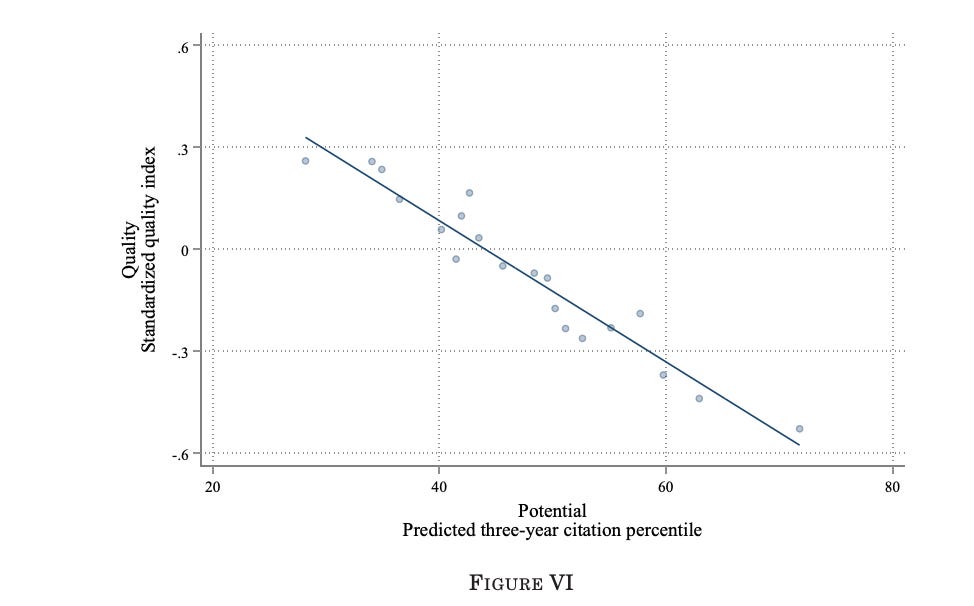
It could be that “high-potential” proteins are intrinsically harder to solve, and that high-potentiality explains the lower quality of the solutions. But when the authors add controls for complexity, the relationship between potential and quality barely changes. In other words, omitted variable bias does not explain the relationship.9
There’s an interesting follow-up question about this paper, which is: how long it takes scientific fields to recover from low-quality work? It’s not obvious that the rushing mechanism described above is welfare-reducing. Perhaps structural biology recovers quickly when someone publishes an incorrect protein structure. The authors conclude that the lower quality due to rushing creates a lot of duplication of effort, and that therefore science is in a coordination dilemma: it would be better for social welfare if scientists could somehow coordinate on not excessively rushing to publish in crowded areas. Indeed, it looks like, in a higher-trust (?) era, social mechanisms partially solved this problem: there used to be a norm in the field that if “someone else is working on [a structure], hands off” (page 1178).
Overall, this is a great paper, and I’m pleased to see the economics of science mature as a field.
Jean Acheson et al., The Elasticity of Taxable Income. Probably the most I’ve enjoyed reading a government report before. See my Progress Ireland essay for an excruciatingly detailed response.
Emmanuel Saez et al., The Elasticity of Taxable Income with Respect to Marginal Tax Rates: A Critical Review. This is the main survey paper in the elasticity of taxable income literature. In economics, there are so few clean natural experiments to choose from that the ones we have get analysed to death. There also just haven’t been that many major tax reforms to begin with. And so, the empirical tax literature is left analysing the Tax Reform Act of 1986,10 the earlier Reagan tax cut, the Kennedy tax cuts, and (as in this paper) the Clinton 1993 tax increases.
Emmanuel Saez is a frequent collaborator with Thomas Piketty, and together with Gabriel Zucman, they make up a trio of French (derogatory11) economists that have come under intense criticism for making hard-to-defend modelling choices in extrapolating from incomplete administrative data. I am not qualified to opine, but, when I have spoken to tax economists off-the-record, some of them have said that Piketty et al. make whichever assumption at each stage that would make inequality (and, by extension, America) look worse. As I hope my essay made clear, there are a lot of modelling choices that go into calculating parameters in public finance theory.
But getting back to this paper, I chuckled at the footnote on page 17, which mentions a public choice theory argument for having a narrow tax base. Brennan and Buchanan in The Power to Tax (1980) argued that the state is a leviathan that tries to maximise revenue – far more revenue than what would be socially optimal.12 Thus, taxes should be designed in such a way that makes it hard to raise extra revenue, that is, distortionary and coming from a narrow tax base. Standard optimal tax theory, like the Mirrlees review, seeks to maximise social welfare subject to raising the required revenue, but if the total amount raised varies with the type of tax, and the government is prone to raising too much revenue, then theoretically, you should invert the Mirrlees recommendations.
In my lifelong quest to come up with the most contrarian takes possible, this would be my steelman of a galaxy-brained reason why the Irish state being extremely reliant on distortionary corporation tax is actually a good thing: because it makes it harder to raise more revenue.
Books
Mark Rippetoe, Starting Strength: Basic Barbell Training (3rd edition). If writing about music is like dancing about architecture, I’m not sure which activities are distant enough in semantic space to describe reading a book about barbell weightlifting. Nonetheless, I found this valuable and entertaining. I’ve been following the programme outlined for about six months and have made steady progress, modulo a lot of travel disruption in the last month. Per my proclivity for humiliating myself on the internet in my quest for self-improvement, I am currently working on a weightlifting essay.
Jay Cummings, Real Analysis: A Long-Form Mathematics Textbook (2nd edition). As we know, following up your weightlifting session by doing problems from a maths textbook is how you achieve the peak male form. This was really quite good, and I found it to be dramatically more intuitive and engaging than Rosenlicht’s Introduction to Analysis. Here is the book’s homepage.
I would recommend this book for anyone considering postgrad in economics; if you want to be comfortable reading theoretical economics research, you need to be familiar with real analysis. For example, economists constantly invoke the concept of compactness (the property that “every open cover has a finite subcover”13), which sounds ridiculously niche but is actually incredibly natural, beautiful, and important.
We’ve been working through this book in my recreational maths meetups, and so far, it’s served as the basis of my meetups on integration, series, and sequences of functions. I find the social environment is the only way I can consistently motivate myself to do the problems at the end of the chapter. When learning alone, I’ve basically given up on textbooks in favour of the Math Academy Way.
In chapter one, Cummings drinks the Kool-Aid on the typical mathematician’s answer that Zeno’s paradoxes are resolved by the existence of infinite series. In reality, no professional philosophers I know actually believe this; according to Brian Skyrms, Zeno’s paradox of measure is in no way solved by the existence of convergent infinite series.
The most knowledgeable person about analytic philosophy I’ve ever met is Peter McLaughlin, and he takes the unpopular-among-philosophers position that, properly defined, calculus as was formalised into real analysis in the 19th century by Augustin Cauchy and others actually does dissolve Zeno’s paradoxes. It’s literally the midwit meme.

My most relevant anecdote about this is a memory I have from when I was around eleven, visiting Galway and excitedly explaining something I had read about Zeno’s paradoxes to my mother. After we walked past a plumber parked in a van with an open window, he said, “Young man, could you come back here and explain that again?” The intellectual lives of the working classes apparently yearn for analysis.
This author loves using the word “porism” in his proofs, which is not a word I had ever heard before. He uses it to mean a “direct result of a proof”, but from what I can tell, modern usage has shifted more toward cases in which a relationship holds for infinitely many values.14
Fun fact, the mathematical meaning of “porism” comes from a mysterious three-volume lost work by Euclid. We only know of its existence thanks to a commentary 600 years later by Pappus of Alexandria. Several mathematicians dedicated their lives to trying to reconstruct Porisms. Euclid’s Elements is a work of unparalleled genius; finding its sequel would be like Christians discovering there was a new book of the Bible.15
If it turns out that Nat Friedman and Luke Farritor are able to decode the lost works of Euclid sitting in the Roman villa excavated as part of the Vesuvius Challenge, then this whole saga would make for a cracking bestselling popular maths book:
Euclid’s Gem: Mount Vesuvius and the 2,000-Year Race to Unlock the Secrets of Ancient Mathematics
As Tom Lehrer recommends, I can then sell the film rights to Metro Golden-Москва for six million rubles.
I remember having done a lot of integrals in my youth without ever learning about all the different ways of formally defining integration, which the author covers in chapter eight. Unless you studied maths, you probably never got beyond the Riemann integral, but there are many others. For example, here is a British public broadcast from 1975 explaining Lebesgue integration – make the BBC great again!
Here are my paraphrases of some of the most fun exercises:
4.29: Prove that every positive rational can be written as a finite sum of distinct Egyptian fractions.
6.61: Without calculating, which is larger, pi^e or e^pi?
7.17: If you’re missing the labels which distinguish the minute and the hour hands on a stopped clock, can you always tell the time?
My favourite chapter was Appendix B, on pathological cases. I had forgotten all about the cross-section of a Menger sponge. I also enjoyed the explanation of the ever-mind-bending Banach-Tarski paradox.
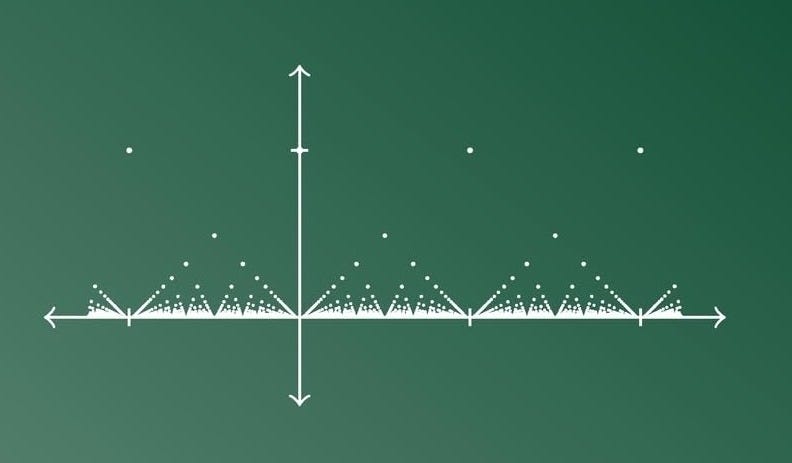
The front cover depicts Thomae’s function, also known as “popcorn”. It is equal to zero when the (real) input is irrational, and then is equal to 1/q when the input is p/q when expressed in its lowest terms. As an exercise to the reader, I will let you prove why this is Riemann integrable:
Films
Rohit Shetty, Chennai Express. My first Bollywood film. This is also only my third Indian film, after S.S. Rajamouli’s RRR and Satyajit Ray’s incredible Pather Panchali.16 This was described by my girlfriend as “timepass”, one of my favourite pieces of Indian English. One of the songs from this film has almost 300 million views on YouTube, which is the same as the number of subscribers (!!!) to the T-Series channel.
A lot of Chennai Express is making fun of North-South Indian cultural differences and stereotypes, but it’s lopsided, with Northerners making fun of dosai, idli, and head-bobbing, and not much of the mockery going the other way. This seems like a missed opportunity to make a satire about the bizarrely disproportionate role that former movie stars have played in Tamil Nadu’s politics, but I suppose I’m overthinking it.
The whole “plot” also hinges on the protagonist’s inability to speak Tamil. This makes everything difficult to follow if you can’t tell Indian languages apart by hearing them; here is my friend Claude Opus 4.7 explaining how to tell them apart as an English-speaker.
That character is played by Shah Rukh Khan (“King Khan”). I was first made aware of Khan’s existence by his appearance on David Letterman. It is genuinely mind-boggling how famous he is.

Greg Kohs, AlphaGo. The documentary about the legendary Go matchup by DeepMind against Lee Sedol in 2016. This entire film is available for free on YouTube. This was my third watch, and (like the previous two) I teared up. The European Go champion Fan Hui is such a delightful character.
My only tiny complaint is that I wish there had been a bit more exposition about the specifics of Go. Here is what it means that the famous move 37 in game two overturned the conventional wisdom about making a “shoulder hit on the fifth line”.17
From YouTube, we have Grant Sanderson on hairy balls and turning spheres inside out.18 Checking in on the world of Minecraft, a man has now reached the “Far Lands”, the place 12.5 million blocks from spawn in a previous version of the game, in which the algorithm’s procedural terrain generation breaks down and starts looking completely bizarre. There is also the Irish cyberpub, and Fuchsia Dunlop on the fundamentals of Sichuanese home cooking.
Ok, technically this is just a blog post, but it does come from the official website for the Jordanian government’s department for issuing fatwas (!).
Because the European Commission doesn’t have nearly the administrative capacity to create a single device regulator for the entire EU (which would also be politically impossible), since the 1980s, the vast majority of medical devices in Europe are approved by private contractors. Through this system, the devices get the famous CE mark. There are some genuinely subtle issues about regulatory harmonisation and the dynamics of European federalism that don’t get much coverage in the endless American blog wars about the FDA. Still: my American friends can walk into a clinic and get incredibly rich data about hundreds of biomarkers within a few days, which they can analyse with the help of AI. I cannot.
Of no relation to Tyler Cowen, to the best of my knowledge.
And, as we know, referendums are un-British. Looking this up was the first time I encountered Grokipedia in the wild. I do not know whether Michael Foot is sufficiently woke to inspire the wrath of Elon.
Compared to, say, Ornette Coleman, Hill still holds on to the more listenable elements of hard bop. One way of thinking about it is this: hard bop is the last subgenre of jazz that anyone could possibly have danced to.
For some strange reason, given how niche a topic it is, my post on spinouts is somehow Progress Ireland’s most popular blog.
This is probably specific to maths, or other domains with verifiable outcomes. This paper uses the GSM8K dataset of simple maths word problems.
They take a few stabs at establishing external validity for other fields, including with surveys (p. 1168).
See section IV.
This is the one that Martin Feldstein (whom I discuss extensively in my essay) was analysing in his 1995 paper.
Tyler Cowen and Alex Tabarrok have highlighted how the views of French economists seem to be more shaped by being French than by being economists. Je plaisante, voyons.
Alas, the evidence for an empirical correlation between fiscal centralisation and having a small state is incredibly mixed. Another beautiful theory, ruined by facts. And of course, you can dispute the premise that the state would raise more revenue than what is socially optimal.
Cummings goes so far as to call this the “greatest definition in mathematics”.
Page 288.
Since writing this, I’ve been informed that Christians actually did discover a new book of the Bible in the 18th century, but then they declined to include it.
RRR is in Telugu, aka ‘Tollywood’, which confusingly is the same name as the Bengali film industry, after the Tollygunge neighbourhood in Kolkata. Pather Panchali is in Bengali, and I was turned on to Ray by an essay by Amartya Sen.
My Claude chat also explains Lee Sedol’s move 78 (“hand of god”) in game four.
For those of you looking for a job or looking to hire, there is also now the 3Blue1Brown career fair.
Impressive consumption AND production! How much time do you spend reading and writing, respectively, each day on average? How are you for real?!